
The Reactor is Critical
News Rundown: Summaries for every major nuclear headline

Veterans of the Naval Nuclear Propulsion Program are no stranger to the phrase, “the reactor is critical.“ Those words are announced during the process of starting up a reactor in preparation for taking one of the fleet’s submarines or aircraft carriers out to sea. After just a few years in the operational community of the Navy’s nuclear program, most members can see this as just another routine evolution.
This past week though, it was anything but a routine evolution that led to use of this phrase.
This weekend we go into great depth to provide details surrounding Antares’ great achievement of initial criticality, along with other major news across the industry including a massive enrichment capacity expansion announcement and the the latest update with the plan to utilize surplus plutonium as nuclear fuel.


Reactor Design and Development
Antares Achieves Criticality of Mark-0 Reactor
The moment most of us in the nuclear industry have been waiting for since May of last year finally arrived:
Antares announced their Mark-0 reactor achieved criticality
While there was certainly no shortage of celebration and praise for those involved in the effort to make this milestone possible, there’s a significantly larger portion of folks hearing about this for the first time that are wondering what all the hubbub is about. Allow us to break down one of the most significant events in recent nuclear industry history:
Executive Summary
On June 4, 2026, Antares brought its Mark-0 microreactor to initial criticality at Idaho National Laboratory. The sodium heat-pipe-cooled, TRISO-fueled design became the first privately developed advanced non-light-water reactor to reach this milestone in the United States in more than four decades. It is also the 53rd reactor built at the INL site since 1951 and the first to succeed under the Department of Energy’s (DOE) Reactor Pilot Program (RPP).
¿Criticality?
Criticality is the point at which a reactor sustains a controlled nuclear chain reaction. Neutron production precisely equals neutron losses, so the fission rate remains steady (critical) rather than dying away (subcritical) or accelerating (supercritical). Antares performed this test at zero-power. Engineers raised power only high enough for precise measurements, typically just watts, with no significant heat or electricity generated. Instruments recorded neutron flux, control drum reactivity, and core physics parameters to validate design models against reality.
Zero-power? Why not full-power?
Antares did a phenomenal job breaking this down, at great length, earlier this year. We covered it in our early March News Rundown and provided some context that we think everyone should take the time to review.

To very briefly summarize: zero-power criticality offers a low-risk, high-information step before full-power operation. Full electricity production, targeted for 2027, requires complete heat removal systems, power conversion hardware, and more rigorous safety cases. By confirming basic nuclear behavior first, teams identify any discrepancies early, refine controls, and build confidence without the expense and complexity of high-power testing. It’s a prudent path for new reactor designs.
Why are we doing this again?
This fulfills part of President Trump’s Executive Order 14301, signed May 23, 2025. That order reformed DOE reactor testing procedures and set a goal of at least three test reactors achieving criticality by July 4, 2026. Antares met its commitment a month ahead of schedule after moving from concept to critical hardware in under 12 months. The effort drew on BWXT TRISO fuel matured and qualified through the Army’s Project Pele and close coordination with DOE, INL, and Army observers.
The moment also recalls Admiral Hyman Rickover’s 1953 memo distinguishing paper reactors from practical ones. On paper, reactors look simple, cheap, and fast to build. In practice, they demand rigorous engineering, supply chain maturity, and disciplined execution. Antares has crossed that threshold with real metal and fuel.
The big takeaway!
This achievement proves the American nuclear industry can deliver at speed when given a clear regulatory pathway and interagency support. Past decades saw few novel reactor tests, so the DOE RPP changed the equation. With initial physics data in hand, Antares will continue with additional zero-power testing while they advance toward electricity generation in 2027 and power deployments in 2028.
Additional reactors are expected to reach criticality before the July 4th deadline. When policy aligns incentives and removes unnecessary friction, the sector demonstrates it possesses both the talent and the will to move from concept to operating hardware on meaningful timelines.
Last Energy Receives DOE Approval of PWR-5 Preliminary Documented Safety Analysis
From out of left field comes Last Energy lurching into 5th place for the most regulation-progressed project in the DOE RPP.
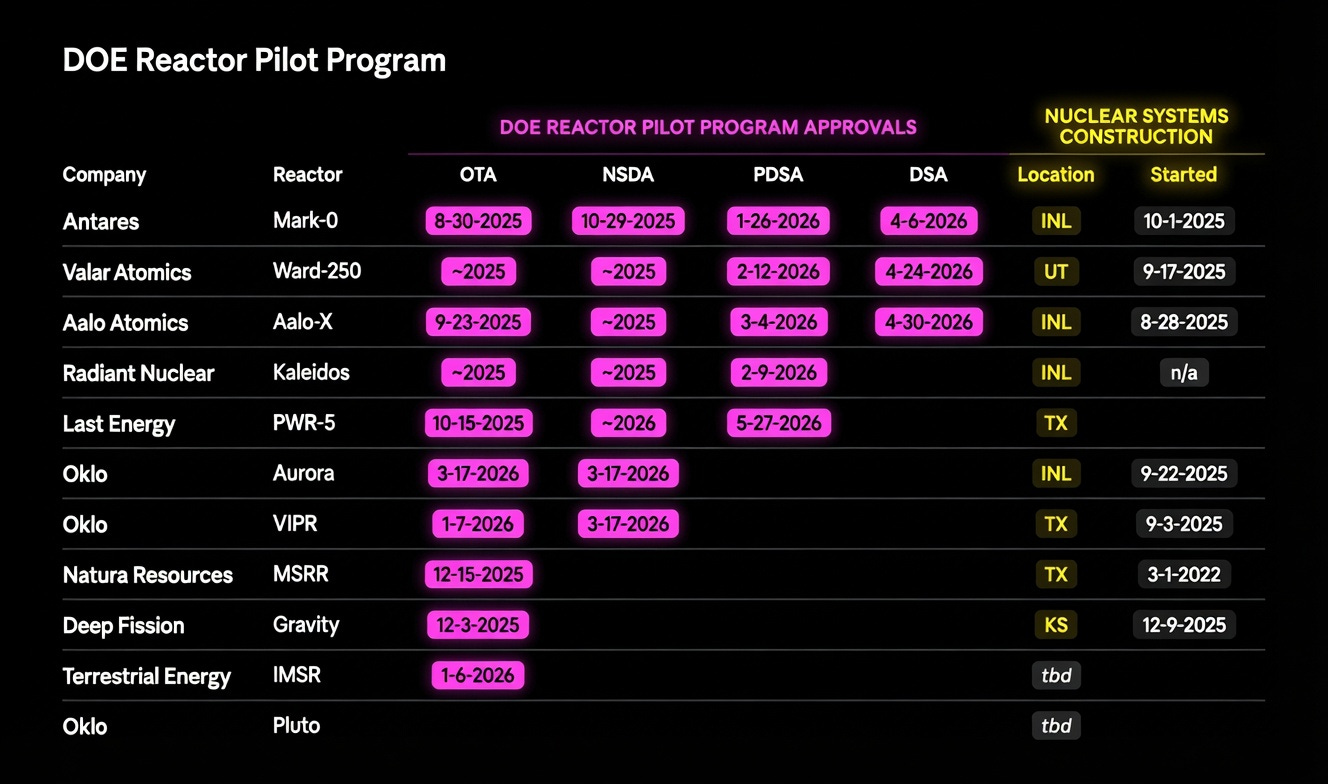
Last Energy secured DOE approval of the Preliminary Documented Safety Analysis (PDSA) for its PWR-5 pilot reactor at the Texas A&M–RELLIS campus. The PDSA defines the preliminary safety basis for the reactor, facility, and operations, detailing hazard analysis, accident mitigation, and controls to satisfy DOE requirements. This step positions the company to complete the final Documented Safety Analysis after construction of the reactor is nearly complete.
At the RELLIS campus, construction is advancing with the building taking shape and key components already on site. Last Energy also reports that their fuel has been manufactured.
The PWR-5 shares identical physical dimensions and reactor geometry with Last Energy’s commercial PWR-20, but operates at reduced power with lower fuel enrichment. The approach rhymes with what companies like Antares are doing by doing extensive testing at zero/lower power. It meaningfully de-risks the 20 MWe design ahead of commercial deployment for industrial customers.
If you’re enjoying the content, please *like* and *restack*
Only takes about 3-5 seconds. Likes and restacks are the primary means of growing on Substack. Thanks for the help, and don’t forget to subscribe!
Blykalla Applies for Government Financing for Advanced Nuclear Reactor Park in Sweden
Blykalla has submitted Sweden’s first application for government financing of an advanced nuclear project, advancing plans for the country’s first lead-cooled reactor park while parallel efforts at other sites gather momentum.
Sweden expects electricity demand to roughly double by 2045 as industry electrifies and AI-driven data centers expand. To unlock the necessary investment, policymakers created a dedicated financing model that entered into force last August.
The framework combines:
Government loans to support the capital-intensive construction phase
Two-way Contracts for Difference (CfD) that stabilize revenues once reactors operate
An overarching risk-and-profit-sharing mechanism
Under the two-way CfD, the developer receives a top-up payment from the state if wholesale electricity prices fall below an agreed strike price. If market prices rise above that level, the project returns the excess revenue to the government. This structure delivers the revenue certainty high-capex nuclear projects require while ensuring taxpayers share in any upside, with terms negotiated project-by-project and subject to EU state-aid review.
The Norrsundet application targets six 55 MWe SEALER reactors in Gavle. The six units would deliver up to 330 MWe of capacity and roughly 2.76 TWh of annual generation. The company’s annual generation estimate implies a capacity factor of about 95%. A lot of the reactor developers have predicted similarly high capacity factors for their reactor plants.
While this number is in line with the large light water reactor fleet in the US, it is extremely difficult to imagine any new reactor design being capable of reaching this with their first-of-a-kind (or the first-several-of-a-kind) reactors. The first couple years, at the absolute least, will likely include numerous engineering and operational headaches that will yield painfully low capacity factors while the companies iterate and optimize their designs.
newcleo, A Developer of Advanced Nuclear Reactors and Nuclear Fuel, to Become Public Company Through Business Combination with NewHold Investment Corp III
This write-up was included last weekend in our Nuclear Sector Newsletter. Due to the company announcing their intentions to go public, any further updates from them will be kept in the Nuclear Sector Newsletter.
Nuclear’s “going public” momentum continues to build as another reactor developer pursues public market access and fresh capital. Newcleo, the Paris-based developer of lead-cooled fast reactors and MOX fuel recycling technology, announced a merger with NewHold Investment Corp III (ticker NHIC). The deal values newcleo at about $2.4 billion and is expected to deliver up to $429 million in gross proceeds. The combined company is slated to list on Nasdaq under the ticker NWCL following an anticipated close in the second half of 2026.
The company already generates revenue (~$80 million in 2024) through its vertically integrated supply chain subsidiaries and employs more than 900 people across seven countries. It has raised approximately $780 million privately since inception, including over $150 million in the past year alone.
newcleo, founded in 2021, has established itself as one of Europe’s most advanced reactor developers. Its 200 MWe lead-cooled fast reactor design, fueled by proprietary MOX produced from reprocessed nuclear waste, targets the dual challenges of reliable clean power and waste reduction.
MOX (mixed oxide) fuel is a nuclear fuel made by blending plutonium dioxide (PuO2) with uranium dioxide (UO2). It is fabricated into ceramic pellets and loaded into reactor fuel assemblies in a very similar manner to how traditional UO2-only pellets are arranged. The primary purpose of MOX is to recycle plutonium recovered from spent nuclear fuel or from dismantled weapons, reducing both the volume of high-level radioactive waste and the need for fresh enriched uranium while maintaining reactor performance.
Lead-cooled reactor designs are chosen over water, gas, or sodium systems primarily for safety and operational simplicity. Unlike pressurized water reactors, lead operates at atmospheric pressure with an extremely high boiling point (over 1700°C), reducing the risk of high-pressure steam explosions and enabling robust passive decay-heat removal through natural circulation and the coolant’s large thermal inertia. Compared with gas-cooled reactors, liquid lead offers far better heat-transfer capability and a better neutron spectrum for facilitating a breeder design. Relative to sodium-cooled reactors, lead is chemically inert, so it doesn’t ignite in air or react violently with water and removes the fire hazard associated with sodium systems.
Traction is ongoing in multiple countries, including a joint venture with Slovakia’s JAVYS (state-owned nuclear company) that aims to deploy up to four 200 MWe units at the Bohunice site while potentially recycling the nation’s spent fuel stockpile. Partnerships with major industrials such as Saipem, Fincantieri, and Danieli target process heat applications for steel, chemicals, and other energy-intensive sectors. In the U.S., newcleo initiated pre-application engagement with the NRC in March 2026. A strategic partnership with Oklo, announced in October 2025, combines newcleo’s MOX expertise with Oklo’s metal-fuel technology. The collaboration received a further boost when Oklo was selected last week by the DOE for advanced negotiations on the Surplus Plutonium Utilization Program as we discussed above.
Studsvik applies to build up to 1,400 MW of new nuclear power at its home site in Nyköping
We have recently added Studsvik to our Nuclear Sector Newsletter. The company is part of a long list of nuclear companies that trade on foreign stock exchanges. SVIK, along with other international tickers, will be tracked in our Nuclear Sector Newsletter going forward.
Studsvik has submitted an application to the Swedish government to build 600-1,400 MWe of new nuclear capacity at and around Nykoping. The company is targeting commercial operation of the first reactors in the 2030s, marking the second government application from within the Studsvik Group this year.
The filing is part of the ReFirm program, one of the more advanced multi-site SMR development platforms in Europe. Studsvik gained the ReFirm program through its acquisition of Karnfull Next earlier this year. Their earlier application, submitted in March for 1,200–1,600 MWe at Valdemarsvik, was the first under Sweden’s new nuclear legislation. The Nykoping project would add two to four light-water reactors to the portfolio, with additional sites at Motala and Karlshamn also under consideration.
Studsvik and Karnfull have not yet announced the reactor technology they’ll be utilizing for these sites, but they have been in discussion for various forms of cooperation with multiple reactor vendors including Rolls-Royce SMR, GE Vernova Hitachi, and Blykalla.
The application is only the opening move in what will be a lengthy permitting process involving the municipality, the Land and Environment Court, and the Swedish Radiation Safety Authority. Studsvik emphasized that continued local engagement will be essential.
Blue Castle project to be revived as SMR facility
Blue Castle Holdings and Fulcrum Point Holdings (both project development companies) announced a joint venture last week to advance the Green River site in Utah through licensing and deployment. The partners intend to work with Holtec to place two to four SMR-300 units on the site, delivering roughly 600 to 1,200 MWe. The effort remains in the preliminary phase, with a timeline and community input process still to be developed.
Blue Castle first surfaced around 2008 and later signed a 2014 MOU with Westinghouse for two AP1000 reactors. Westinghouse’s 2017 bankruptcy, shifting economics, and repeated licensing delays left the project dormant for years. Water rights were secured after a multi-year court battle, and substantial site characterization was completed.
Holtec’s SMR-300 includes an optional air-cooled condenser system well suited to Utah’s arid climate, directly addressing one of the historical concerns around water use. The design is already moving through NRC licensing at the Palisades site in Michigan, where Pioneer Units 1 and 2 represent the lead deployment.
The state’s Operation Gigawatt initiative, driven by Governor Spencer Cox, aims to double Utah’s electricity generation capacity by 2034 and has increasingly focused on nuclear as a reliable, high-density option. The Blue Castle revival joins other nuclear activity in the state, including a separate Holtec SMR-300 project in Brigham City also linked to the Fulcrum Point team.
Environmental (spoken “anti-nuclear”) groups such as HEAL Utah continue to raise questions about water use, radioactive waste (they want a long-term solution, but also plan on rejecting all of the ideas), and long-term costs to taxpayers. Groups like HEAL will undoubtedly be present at the many public hearings to come, and will likely go above and beyond to delay the project by any means necessary.
Fuel, Manufacturing, and Services
DOE selects five companies to negotiate receipt of surplus U.S. plutonium
The DOE has selected five nuclear companies for advanced negotiations to receive and process surplus US plutonium into fuel for next-generation reactors. This marks a clear policy shift under the Surplus Plutonium Utilization Program (SPUP) from long-term disposal toward productive reuse of legacy fissile material.
Plutonium-239 is a highly fissile isotope with exceptional energy density. It can be fabricated into mixed-oxide (MOX) fuel, TRISO particles, metallic fuel forms, or incorporated into molten salt systems to sustain fission in advanced reactor designs. The SPUP offers nearly 20 metric tons of DOE-owned material (4.4 metric tons in metal form and 15.3 metric tons as oxide) drawn from the department’s larger inventory of approximately 61.5 metric tons of weapons-grade plutonium declared surplus to national security needs after post-Cold War stockpile reductions.
For more than a decade, US plutonium policy centered on the canceled MOX Fuel Fabrication Plant at Savannah River and a subsequent dilute-and-dispose approach that would have blended the material with inert adulterants for burial. The new SPUP, established following executive orders directing the repurposing of surplus inventories, instead emphasizes “disposition through use.”
Selected companies will stabilize, process, fabricate, and irradiate the material under DOE security, safeguards, and international monitoring requirements, converting a decades-old storage and security liability into domestic clean electricity while fissioning transuranics to reduce long-term radiotoxicity.
Oklo plans to use the plutonium as bridge fuel for its Aurora reactors. The company is partnering with newcleo to establish US fuel fabrication infrastructure. Oklo noted that converting material previously slated for disposal into fission energy can bring more reactors online sooner. The selection aligns with Oklo’s broader fast-reactor and used-fuel recycling strategy.
Flibe Energy views the surplus plutonium as an ideal feedstock for its thorium reactor molten salt designs, where it can sustain extended operations and complement the company’s ongoing work recycling used nuclear fuel. CEO Kirk Sorensen emphasized that the opportunity aligns with Flibe’s principle of treating the nation’s surplus fissile materials as strategic assets to be preserved and put to productive use rather than discarded.
Standard Nuclear intends to fabricate plutonium-bearing TRISO particles for supply to any advanced reactor developer. The approach builds on the “Deep Burn” concept, in which transuranic elements encapsulated in silicon carbide-coated particles are irradiated to generate electricity while significantly reducing long-term radiotoxicity. Historical U.S. demonstration of plutonium TRISO irradiation at Peach Bottom in the early 1970s positions the spent fuel as essentially repository-ready.
SHINE Technologies proposes chemically processing the surplus plutonium to recover americium for radioisotope applications through partnerships with Zeno Power and Orano, while purifying the remaining plutonium for blending with uranium into advanced reactor fuel. The selection builds on SHINE’s more than a decade of experience handling nuclear materials, performing separations, and advancing used-fuel recycling in collaboration with DOE and national laboratories.
Exodys Energy plans to apply its proprietary recycling chemistry that co-recovers uranium and transuranic elements without ever isolating a pure plutonium stream, allowing the surplus material to be diluted directly into used nuclear fuel feedstock suitable for both the existing commercial fleet and advanced designs. CEO Carl Perez described the moment as one in which decades-old federal liabilities can be transformed into clean electricity for American homes, hospitals, and industry through recycling infrastructure now under development.
Deep Isolation Reaches Over 100 Issued Patents, Strengthening Global Leadership in Nuclear Waste Disposal Innovation
Deep Isolation crossed an important intellectual property milestone, announcing more than 100 issued patents worldwide for its deep borehole nuclear waste disposal technologies. The company has built a broad portfolio covering:
repository architecture
geologic site characterization
canister and packaging systems
emplacement and retrieval methods
long-term monitoring
The core innovation uses directional drilling techniques, long proven in the oil and gas sector, to isolate spent nuclear fuel and high-level radioactive waste deep underground in boreholes that can run horizontally, vertically, or at a slant.
In January 2026, Deep Isolation launched a full-scale, at-depth Commercialization Pilot near Cameron, Texas, in partnership with Halliburton, Amentum, NAC International, and the Deep Borehole Demonstration Center. This multi-year, non-radioactive demonstration is testing drilling, canister handling, and emplacement operations underground to generate operational data and build regulatory confidence ahead of commercial deployment.
Kairos Power Earns ISO 9001:2015 Certification for Alameda Manufacturing Facility
Kairos Power earned ISO 9001:2015 certification for its Alameda, California, manufacturing facility, strengthening its quality systems as it advances the Hermes reactor demonstration programs. Hermes 1 low-power demonstration reactor construction is underway, and Hermes 2 broke ground in April.
The certification covers parts manufacturing and continuous improvement at the Alameda site, which focuses on test skids and R&D fabrication. It follows last year’s certification at Kairos Power’s Albuquerque Manufacturing Development Campus for larger-scale components. The audit closed with zero findings, reflecting solid process discipline.
ISO 9001 provides a recognized quality management framework that nuclear developers can supplement with stricter standards for safety-related hardware. This layered approach reduces delivery risks and builds confidence for more demanding production.
Urenco USA Plans Significant Expansion Of U.S. Uranium Enrichment Capacity
Urenco announced plans to expand its National Enrichment Facility in Eunice, New Mexico, by nearly 50%. The multi-billion-dollar investment will add 2.1 million separative work units (SWU) of new capacity via up to 24 gas centrifuge cascades. Initial production is slated for 2032, with additional cascades coming online through 2036.
The facility currently runs at 4.3 million SWU annually, roughly one-third of US commercial demand of about 15 million SWU per year. An ongoing project adding 700,000 SWU completes in 2027, alongside refurbishment work starting that year. These steps will push total site capacity above 7 million SWU over the next decade.
The timing aligns with US efforts to end reliance on Russian enriched uranium imports averaging 3-4 million SWU annually (~25% of domestic needs). The 2024 Prohibiting Russian Uranium Imports Act phases out those supplies by 2028 after waivers expire. This domestic expansion helps close that gap while also supplying LEU feedstock for HALEU production required by advanced reactors in the 2030s.
If this is about as clear as mud, we did a thorough breakdown of some of the terminology used here that is worth reading through again: link
Curio® Begins Application Process for Part 70 Operating License for NuCycle® Used Nuclear Fuel Recycling Production Facility
Curio has taken the first formal step toward licensing what would become the first commercial-scale used nuclear fuel recycling facility in the United States in decades. The company submitted a letter of intent to the NRC to establish a 10 CFR Part 70 docket for pre-application engagement and eventual operating license review for its NuCycle plant. Site selection is still underway.
The facility is designed to process up to 4,000 metric tons of light-water reactor spent fuel annually. Curio’s proprietary “voloxidation” process recovers enrichable uranium hexafluoride (UF6), produces a proliferation-resistant transuranic TRUFuel, and extracts valuable isotopes.
It can handle conventional LWR fuel, HALEU, and certain DOE-managed high-enriched materials, with an integrated staging facility for controlled feedstock handling. The company plans to begin submitting white papers and topical reports to the NRC in late 2026 or early 2027.
Curio is coming up to the NRC’s doorstep alongside parallel licensing and construction activity across the front end of the supply chain, where multiple projects are advancing to rebuild domestic enrichment and fuel manufacturing capacity:
Radiant Industries recently secured NRC acceptance of its Part 70 application for the fueling building at its R-50 microreactor production facility in Oak Ridge, Tennessee, triggering an expedited eight-month review
General Matter is preparing a full license application for submission in 2026 for an enrichment plant at the former Paducah Gaseous Diffusion Plant site under a DOE lease
Global Laser Enrichment’s Paducah Laser Enrichment Facility application is undergoing NRC environmental scoping to re-enrich depleted uranium tails using SILEX laser technology
Orano is also going through the motions for the $5 billion Project IKE gas centrifuge enrichment facility near Oak Ridge, for which the NRC has launched an accelerated 12-month technical review
Policy, Regulation, and Industry
U.S. Navy to power Norfolk base using aircraft carrier
The U.S. Navy plans to test a practical demonstration of mobile nuclear power this summer by exporting electricity from the aircraft carrier USS Gerald R. Ford to Naval Station Norfolk. Acting Secretary of the Navy Hung Cao disclosed the effort during May congressional testimony on the service’s fiscal 2027 budget, framing it as one element of a broader strategy to deliver firm baseload power for energy resilience and mission assurance at naval installations.
The Ford has two A1B pressurized water reactors, engineered by Bechtel with cores and nuclear components from BWXT, that generate substantial electrical capacity beyond the ship’s needs while in port. The demonstration will assess the infrastructure and procedures needed to deliver this power ashore, potentially supporting base operations during grid outages or surge requirements.
Russia leads in actual deployment of the floating nuclear barge concept with the Akademik Lomonosov. This floating nuclear power plant, equipped with two KLT-40S reactors rated for roughly 70 MWe, has supplied the remote Arctic community of Pevek since December 2019. Rosatom regards the unit as a successful prototype for future floating plants and onshore small modular reactor applications in isolated regions.
If you’re enjoying the content, please *like* and *restack*
Only takes about 3-5 seconds. Likes and restacks are the primary means of growing on Substack. Thanks for the help, and don’t forget to subscribe!
Constellation’s Three Mile Island nuclear restart gets boost with FERC waiver
Constellation Energy secured a critical regulatory boost for restarting the Crane Clean Energy Center (formerly Three Mile Island Unit 1) when FERC approved a waiver to transfer 760 MW of Capacity Interconnection Rights from its Eddystone plant. The move helps resolve transmission constraints that threatened to strand the 835-MWe reactor after restart.
Constellation’s $1.6 billion restart, backed by a 20-year Microsoft PPA for data center power, has targeted a second-half 2027 return to service. PJM studies, however, flagged hundreds of miles of new transmission lines, not expected until December 2030 or later, as contingent facilities required for full deliverability. This raised the risk of the plant sitting largely idle for years post-restart.
The project timeline has been all over the place. Announced in September 2024 with an initial 2028 target, it was advanced to 2027. Then in March 2026, PJM’s preliminary analysis pointed to a potential 2031 full grid connection, prompting Constellation’s FERC waiver request on March 31. Though opposed by the grid operator’s independent market monitor, FERC found the transfer would enable more efficient use of existing rights and support full operations before the end of 2030 while improving interim deliverability.
This episode illustrates how interconnection and transmission bottlenecks can introduce volatility into otherwise straightforward nuclear restarts at well-maintained brownfield sites. By leveraging regulatory flexibility, Constellation has largely restored alignment between its generation readiness timeline and grid access.
New York opens RFQ, RFA windows for nuclear development and workforce
New York advanced its nuclear development efforts as the New York Power Authority issued a Request for Qualifications (RFQ) for reactor developers and a $40 million Request for Applications (RFA) to expand the nuclear workforce pipeline.
The RFQ seeks developers for large reactors or SMRs that can start construction before 2033, targeting at least 1 GW of new upstate capacity eligible for federal tax credits. Acceptable pathways include established designs such as the Westinghouse AP1000 and GVH BWRX-300. It builds on prior RFIs that attracted over 30 responses from developers, partners, and upstate communities and serves as the first stage toward a potential RFP.
The companion RFA distributes $40 million over four years to New York-based training providers, including technical high schools, community colleges, universities, unions, manufacturers, and tribal organizations. Proposals are due July 31, with an informational webinar on June 18. Funding supports hands-on training, apprenticeships, and job placement, with emphasis on nuclear-ready communities and economically distressed regions under the NextGen Nuclear New York program.
NextEra Energy and Dominion Energy to Combine, Creating the World’s Largest Regulated Electric Utility Business and North America’s Premier Energy Infrastructure Platform Benefiting Customers
The announcement that NextEra Energy and Dominion Energy will combine in an all-stock transaction is being framed primarily around regulated utility scale and customer bill credits. Yet for us, the real story is the creation of the second largest nuclear fleet in the US: 14 operating reactors across seven sites in five states, all under one corporate roof once the deal closes in 12-18 months (subject to NRC approval and other regulatory nods).
NextEra Energy’s Current Operating Reactors (7 units)
Turkey Point Nuclear Generating Station, Units 3 & 4 - Homestead, Florida
St. Lucie Nuclear Power Plant, Units 1 & 2 - Jensen Beach, Florida
Point Beach Nuclear Plant, Units 1 & 2 - Two Rivers, Wisconsin
Seabrook Station, Unit 1 - Seabrook, New Hampshire
Dominion Energy’s Current Operating Reactors (7 units)
Millstone Power Station, Units 2 & 3 - Waterford, Connecticut
North Anna Power Station, Units 1 & 2 - Mineral, Virginia
Surry Power Station, Units 1 & 2 - Surry, Virginia
V.C. Summer Nuclear Station, Unit 1 - Jenkinsville, South Carolina
Also worth noting is NextEra is working with Google to restart the Duane Arnold Energy Center in Iowa, a 615 MW boiling water reactor. Dominion is also working on nuclear expansion with evaluations underway for building SMRs in Virginia at the existing North Anna Power Station.
Something Missing?
Looking for the other major headlines announced this week? Well, they’re probably covered in our other bi-weekly report, the Nuclear Sector Newsletter, that focuses on the publicly-traded side of the nuclear industry. It’s $5/month for coverage of all the public nuclear companies and comes with coverage for quarterly earnings and major announcements. Don’t forget the huge trove of these reports we’ve stacked up for our subscribers to read through as well!
You’ll find all the announcements from the 19 core nuclear companies: Cameco, BWXT, Mirion Technologies, Graham Corp, Perma-Fix, Studsvik, Holtec, Oklo, X-energy, NuScale, Nano Nuclear, Terra Innovatum, Terrestrial Energy, Hadron Energy, Newcleo, Deep Fission, Centrus Energy, Silex Systems, and Lightbridge.
Coverage is also included for all the nuclear-related headlines coming from 30 nuclear-adjacent companies such as Constellation, Vistra, GE Vernova, Rolls-Royce, Curtiss-Wright, Flowserve, Solstice Materials, ASPI, Energy Fuels, Fluor, Amentum, and Fermi.